Compare consumable packs by the usable quantity you will actually finish
A larger pack can have a lower unit price while costing more in the context of your own use. Calculate the comparable unit, then consider waste, storage and timing separately. The arithmetic should clarify the offer rather than turn every bulk discount into a reason to buy more.
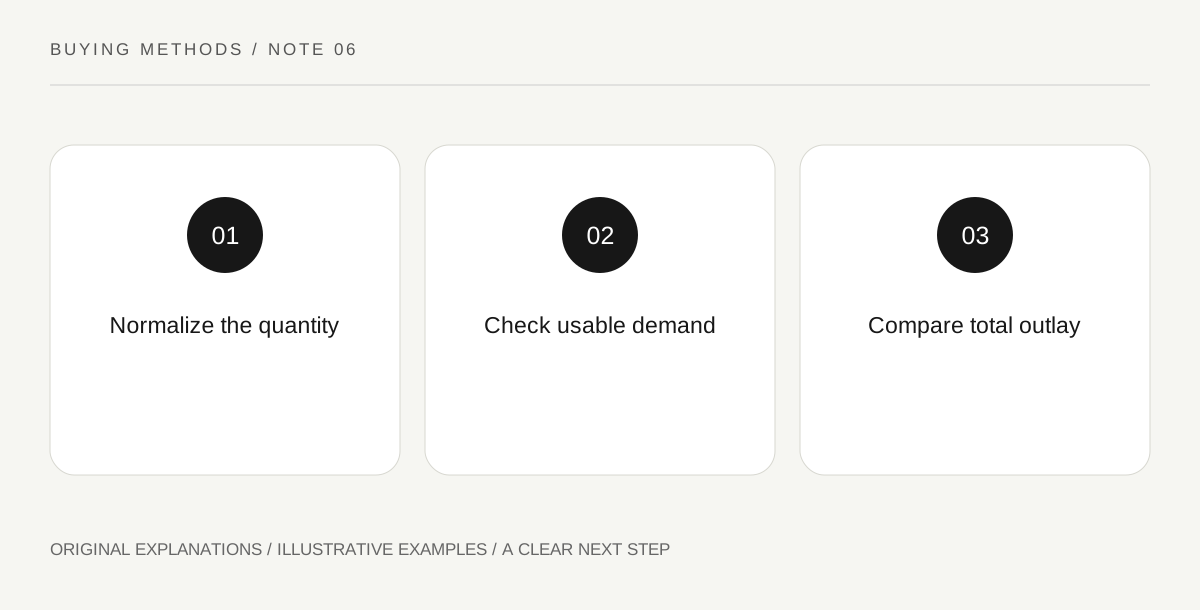
Original explanatory diagram. Read the full method and limitations below.
Choose one comparable unit
Read the actual quantities and convert them into the same unit before dividing price. A pack count is useful only when the items are equivalent in size and specification. For a refill, compare the supported usable quantity rather than the package's outside dimensions. Keep the calculation simple and show the inputs. The FTC recommends comparison shopping and reading offer details; a unit-price calculation is an original way to make those details easier to assess.
Keep compatibility outside the price arithmetic
A cheaper refill that is not approved for the intended product is not an equivalent option. Confirm the actual model and manufacturer guidance before treating two consumables as substitutes. Do not use a lower price to justify unsupported mixing, dilution or installation. If compatibility remains unclear, leave that candidate unresolved. The correct denominator cannot rescue a comparison between items that do different jobs or carry different operating requirements.
Add a realistic use horizon
Estimate how much you ordinarily use before the product's relevant expiry, opening or storage limit, using actual label guidance. Keep this as an assumption rather than a promise. A bulk pack can create waste if the household cannot use it appropriately. Storage space and ease of access also matter. Do not invent a longer shelf life because the unit cost is attractive or assume a sealed outer package makes every component suitable indefinitely.
Compare the complete spending decision
Show the total outlay beside the unit price. Ask whether the larger commitment fits the actual need and budget. Buying the smaller pack may be reasonable even when its unit price is higher, because it limits unused stock and keeps the purchase manageable. Record any uncertain assumption that could change the conclusion. The exercise is practical consumer arithmetic, not an investment forecast or a guarantee that a particular pack saves everyone money.
Illustrative worked example
Illustrative arithmetic: a compatible ten-unit pack costs 18 currency units, while a four-unit pack costs 9. Their unit prices are 1.80 and 2.25. A household expects to use only four units within the relevant supported period and has no suitable use for the remainder. The lower unit price therefore does not automatically make the larger total purchase preferable. These are fictional prices, not current offers.
Questions that come up
Does the lowest unit price always win?
No. Total spending, usable quantity and compatibility also matter. Keep those factors visible instead of allowing one attractive ratio to decide the whole purchase.
Can I divide a pack with a friend?
Only consider it when the product can be shared appropriately with labels, safe packaging and instructions preserved. Do not create ambiguous unlabelled containers to chase a discount.
References and scope
These sources support the factual background. Examples and exercises are original illustrative teaching material. References do not imply endorsement.
- FTC: Online Shopping — Compare sellers, products and terms and keep purchase records; no universal refund entitlement is inferred.