Break a product bundle into required, useful and unwanted components
A bundle can simplify a purchase or hide several objects you would never choose separately. List its actual components before assigning value to the discount. Keep necessary approved parts, optional conveniences and unwanted extras distinct, with the complete operating setup as the comparison target.
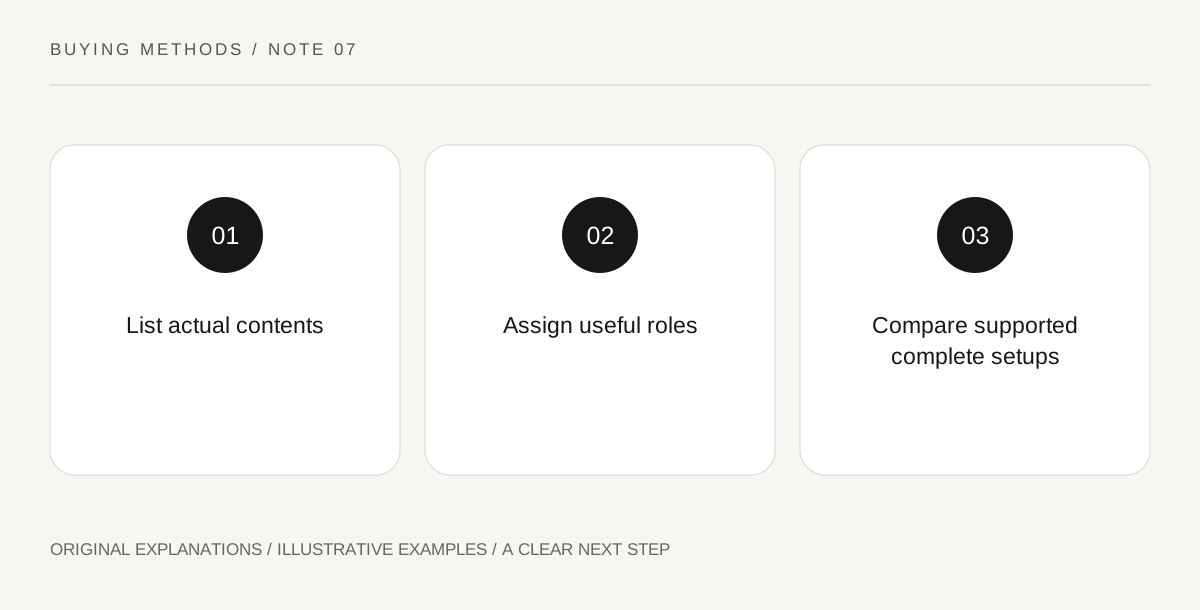
Original explanatory diagram. Read the full method and limitations below.
List the package contents literally
Copy the included items and quantities from the actual offer. Do not fill gaps from a promotional photograph whose props may not be included. Identify the core product and any parts necessary for its intended supported use. The FTC's online-shopping guidance encourages checking the actual offer details; a component ledger makes that check inspectable. If a required adapter or attachment is absent, record the gap rather than assuming the seller will supply it after delivery.
Assign each item a real role
Mark an accessory required only when the manufacturer's instructions or actual task make it necessary. Useful means you have a plausible planned use, while unwanted means you would not otherwise choose it. Avoid inflating the bundle's value by adding advertised standalone prices for objects you do not want. An unused extra still occupies storage and may require disposal later. A matching color scheme is a preference, not proof that every object is operationally necessary.
Verify the supported combinations
Check that the bundled parts belong to the stated model and operating system. A package assembled by a retailer may need independent confirmation of compatibility. Do not assume that being sold together overrides manufacturer restrictions. Keep batteries, chargers, structural accessories and food-contact components within their intended uses. If the seller cannot clarify a material mismatch, pause that offer rather than treating an attractive discount as a substitute for a supported setup.
Compare complete paths to the same result
Place the bundle total beside the core product plus only the required and genuinely useful extras bought separately. Include disclosed delivery and other relevant charges. Keep actual current prices dated; any hypothetical comparison should be labeled as such. The bundle may still be the best fit, but the reason should be clear. Do not count a large advertised saving from an unexplained reference price as equivalent to money your household would otherwise have spent.
Illustrative worked example
Illustrative scenario: a hobby starter bundle contains a core tool, one required compatible accessory, several decorative cases and a second attachment with no planned use. The shopper compares the supported core setup separately and discovers the bundle is only attractive if they actually want the cases. They choose based on that preference openly, without pretending every extra is a necessary saving.
Questions that come up
Can I add all standalone list prices to prove the bundle's value?
Only if those are meaningful alternatives you would actually consider, and the prices are current and comparable. Unwanted objects do not create useful savings merely by carrying a price tag.
Does a retailer bundle guarantee manufacturer compatibility?
Do not assume it. Check the actual models and supported combinations, particularly where safe operation or required accessories are involved.
References and scope
These sources support the factual background. Examples and exercises are original illustrative teaching material. References do not imply endorsement.
- FTC: Online Shopping — Compare sellers, products and terms and keep purchase records; no universal refund entitlement is inferred.