Read a review for the task it actually observed
A five-star review may concern fast delivery while your question is whether a product fits a particular task. Sort reviews by what they can support before counting enthusiasm. The aim is useful evidence with limits, not a homemade detector that claims to identify every fake review by writing style.
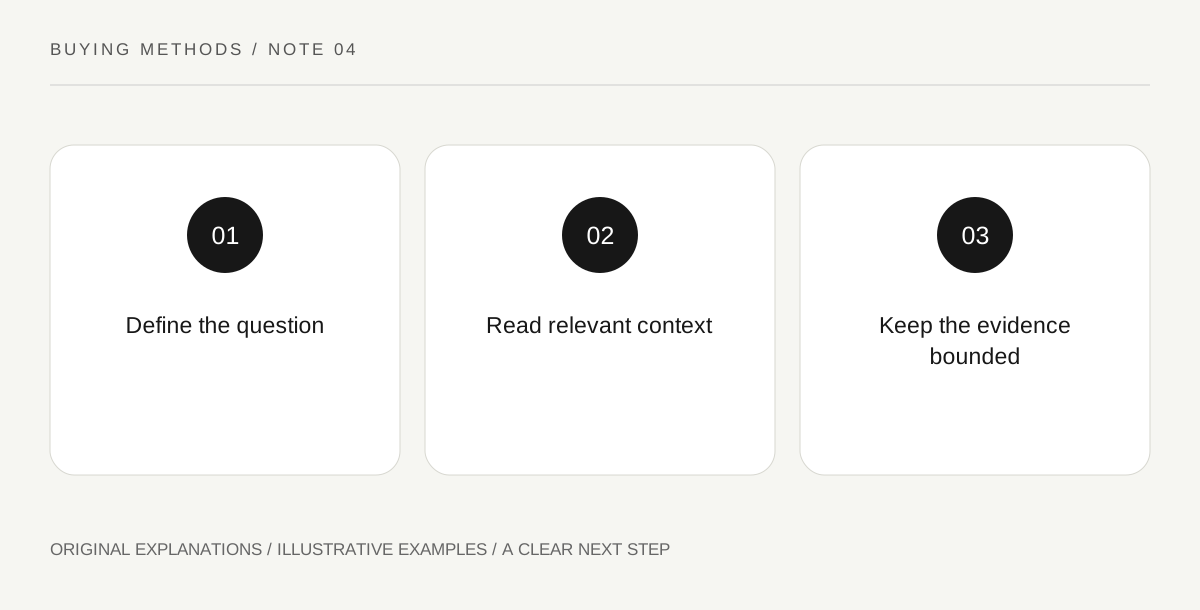
Original explanatory diagram. Read the full method and limitations below.
Write the question before reading opinions
Choose one practical question such as whether a closure is easy to operate or whether a device supports the required connection. Then look for reviews that describe that action with enough context to be informative. A comment about packaging does not establish long-term reliability. A complaint about a late parcel may concern the seller rather than the product design. Keep those categories separate instead of forcing every star rating into one general quality score.
Check identity and context
Look for the model, variant and date relevant to the review. A platform may combine comments about different sizes or generations, so do not assume every paragraph describes the item currently selected. Note the reviewer's actual use conditions when provided. A product that failed one unusual task might still suit another, while a glowing account of a different connection or accessory does not answer your compatibility question. Missing context should reduce certainty rather than invite invented details.
Consider incentives without pretending certainty
The FTC advises considering review sources and warns that appearance alone cannot reliably distinguish every genuine review from a fake one. Read available incentive disclosures and compare multiple appropriate sources. A short review is not automatically false, and a detailed one is not automatically independent. Treat suspicious patterns as reasons for caution and further checking, not proof that a named person lied. Manufacturer specifications and other primary information still have their own role.
Convert the review into a bounded note
Write what the review supports, what remains unknown and what source could resolve the gap. A useful note might say one user reports easy access with this model, but the manufacturer still needs to confirm my device compatibility. Do not turn repeated anecdotes into an invented failure rate. If the important question remains unresolved, pause the purchase or choose a clearer option rather than allowing the sheer number of ratings to supply an answer.
Illustrative worked example
Illustrative scenario: a shopper sees hundreds of positive comments on a compact appliance. Most concern delivery and appearance, while the buyer needs a particular removable part for cleaning. They find a relevant model-specific account and then confirm the part in the manufacturer's documentation. The final decision uses the review as a lead, with the critical fact supported separately.
Questions that come up
Can polished writing prove a review is fake?
No. The FTC cautions against assuming appearance can reliably settle authenticity. Consider source, context and corroboration instead of claiming a writing-style verdict.
Do repeated complaints reveal a precise failure rate?
Not without a valid denominator and representative evidence. They can identify a question to investigate, but they do not automatically quantify the whole product population.
References and scope
These sources support the factual background. Examples and exercises are original illustrative teaching material. References do not imply endorsement.
- FTC: Evaluating Online Reviews — Review sources and incentives matter; appearance alone cannot reliably identify every fake review.
- FTC: Online Shopping — Compare sellers, products and terms and keep purchase records; no universal refund entitlement is inferred.