Compare ownership costs with the assumptions left visible
A low purchase price can sit beside recurring consumable, energy or service costs. Build a simple scenario using reliable product information and your own stated use assumptions. The result is an estimate to inspect, not a forecast that claims every household will experience the same cost.
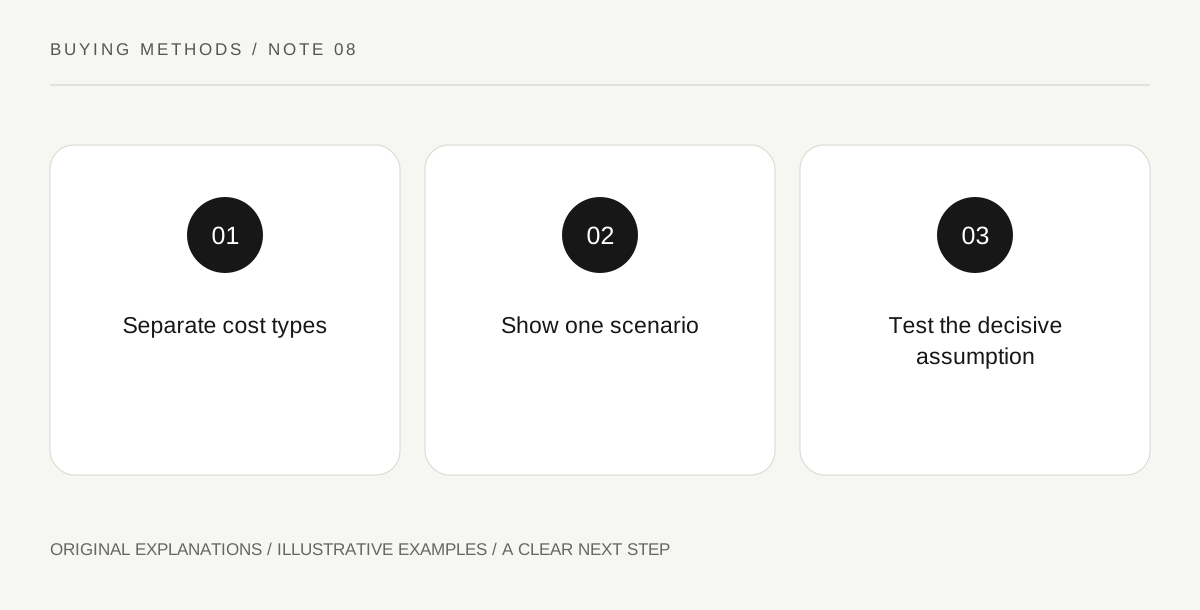
Original explanatory diagram. Read the full method and limitations below.
Separate fixed and recurring items
Write the purchase total and required setup separately from ongoing costs. Include only costs relevant to the actual product and task. A refill, subscription or scheduled service can matter more than an optional decorative accessory. Do not infer a replacement interval from a review if the manufacturer provides product-specific guidance. Keep unknowns visible. A comparison with blank fields can still identify the question to ask before buying, while invented precision conceals that question.
Use one clearly labeled scenario
Choose a time horizon and a realistic usage assumption, then show how each recurring item is calculated. If the scenario changes, the result changes. Use the same basis across candidates so one is not credited with light use while another is charged for heavy use. The FTC advises comparing complete purchase information; this original worksheet extends that habit into ownership. It does not establish a guaranteed lifespan or a probability that a repair will occur.
Test the assumption that matters most
Identify which uncertain input could reverse the decision. A replacement cartridge price or a required subscription may be more influential than a small purchase discount. Try a second plausible scenario rather than claiming a single exact answer. Keep safe and supported operation constant; do not assume savings from skipping required maintenance, using incompatible parts or extending a replacement interval beyond reliable guidance. A lower estimate built on unsupported care is not a comparable ownership path.
Choose with both cost and practical fit
A product can have a slightly higher scenario cost while better fitting the task, storage or accessible controls. State that tradeoff instead of hiding it inside a subjective score. Date actual prices and retain the source for recurring charges. Review only when a material term changes. The worksheet should make a decision easier, not create a complex model whose impressive totals depend on guesses about ten years of unknown repairs and future prices.
Illustrative worked example
Illustrative arithmetic: candidate A costs 80 currency units and uses a 15-unit refill twice during the chosen scenario; candidate B costs 100 and uses a 10-unit refill twice. The totals are 110 and 120 before any other stated costs. If the expected refill count changes, the comparison changes too. These fictional numbers demonstrate visible assumptions rather than real product savings.
Questions that come up
Should I include a guessed catastrophic repair?
Do not present an unsupported event as a known cost. You can describe the uncertainty separately or use reliable actual coverage and service information.
Does the lowest modeled total prove the best purchase?
No. The model covers stated assumptions and costs. Practical fit, supported use and uncertainty remain part of the decision.
References and scope
These sources support the factual background. Examples and exercises are original illustrative teaching material. References do not imply endorsement.
- FTC: Online Shopping — Compare sellers, products and terms and keep purchase records; no universal refund entitlement is inferred.
- FTC: Warranties — Read written coverage and distinguish included warranty from separately sold service contracts; details vary.
- FTC: Trials and Auto-renewals — Read billing, renewal and cancellation details; this collection does not assert a universal current legal cancellation rule.