Check the delivery path for the whole packaged object
A product can fit its intended room while its package cannot reach it easily. Review the delivery route before ordering a bulky item. Include door openings, turns, handling requirements and the seller's actual service boundaries, rather than treating a single destination measurement as a complete access plan.
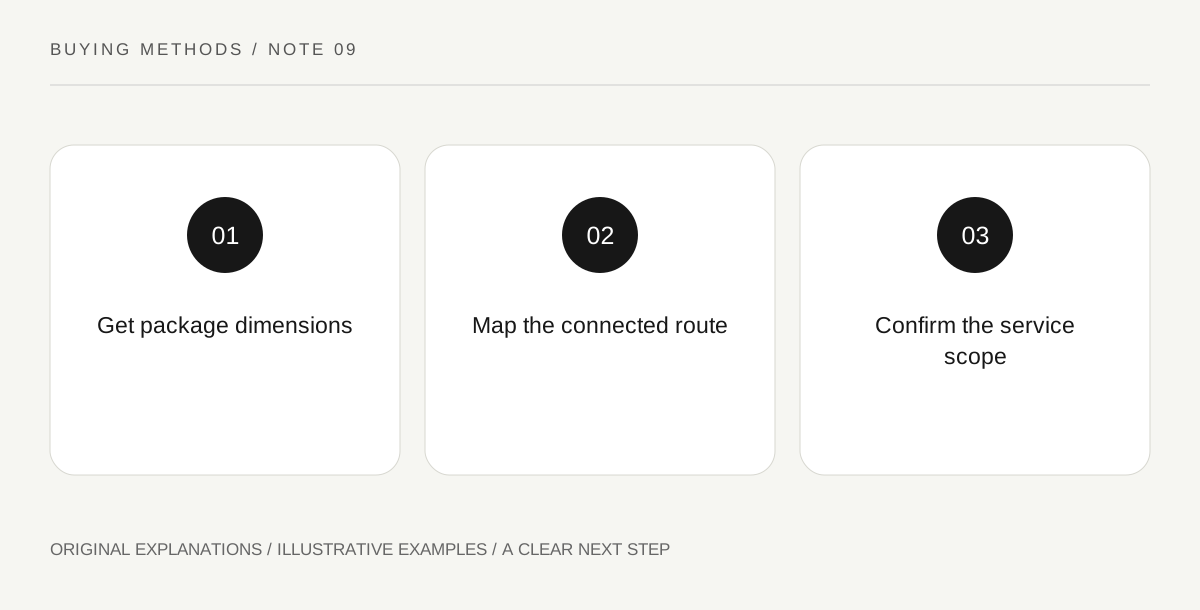
Original explanatory diagram. Read the full method and limitations below.
Distinguish product and package dimensions
Obtain the exact model's dimensions both assembled and packaged when available. A protective carton, base or protruding handle can change the required clearance. Do not substitute a similar product's numbers or assume the object can be unpacked anywhere along the route. Ask what the seller's delivery service allows. Some items require approved professional installation or handling, and a shopping comparison should not become an improvised moving or assembly instruction.
Walk the route as connected stages
Map the entrance, corridors, stairs, lift where applicable and final room. Consider turns and usable opening space as well as straight widths. Keep measurements conservative and note uncertainties rather than squeezing the arithmetic to make a preferred product appear possible. Building rules and access needs may matter. If the route is complex, seek the seller's or qualified installer's assessment. A paper sketch can reveal a question without certifying that a heavy object can be moved safely.
Read the delivery service definition
Find out whether the offer covers doorstep delivery, a designated room, installation or removal of packaging. The terms can differ, so do not infer them from free shipping. Ask about failed-access arrangements and any disclosed extra services before checkout. Keep the written answer with the offer. This article provides a planning method rather than a universal statement of delivery law; the actual contract and local requirements need their own review when a dispute arises.
Plan the arrival without risky improvisation
Arrange appropriate access and assistance through the supported service. Do not remove structural fittings, bypass building rules or attempt an unsafe lift because the truck has arrived. Inspect the delivered identity and visible condition according to the seller's process before committing to unsupported setup. If the object cannot be delivered as planned, pause and use the agreed route. A delayed purchase is preferable to making the household solve an unresolved access problem under pressure.
Illustrative worked example
Illustrative scenario: a shopper measures a cabinet alcove but overlooks a tight hallway turn. The packaged dimensions and a route sketch reveal the uncertainty before ordering. They ask the delivery provider to assess access and clarify what room delivery includes. The final choice uses that answer rather than assuming the carton can be removed and the object tilted through any doorway.
Questions that come up
Does fitting in the room prove delivery will work?
No. Access involves a connected route and the packaged object as well as the final space. Resolve material uncertainties before ordering.
Does free delivery include installation?
Only the actual service terms can answer that. Read the offer and ask about the specific setup rather than treating a shipping phrase as a complete service package.
References and scope
These sources support the factual background. Examples and exercises are original illustrative teaching material. References do not imply endorsement.
- FTC: Online Shopping — Compare sellers, products and terms and keep purchase records; no universal refund entitlement is inferred.
- FTC: Resolving Problems with a Business — Keep relevant records and use appropriate business support and consumer resources when a problem remains unresolved.