A recall can concern one component inside an otherwise familiar product
A product-safety notice may identify a model, component or production range more narrowly than the name printed on a storefront. Read the actual notice and match the specified information. Keep the remedy with the affected item rather than assuming that a familiar product name establishes either inclusion or exclusion.
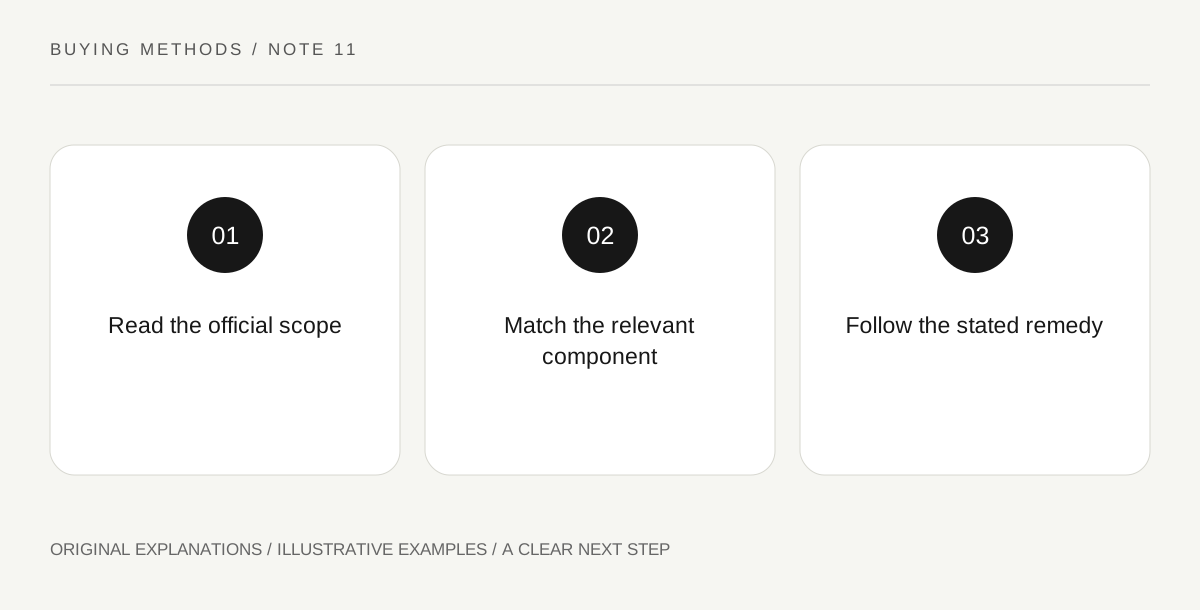
Original explanatory diagram. Read the full method and limitations below.
Start from an authoritative notice
Use the relevant official product-safety source and manufacturer information for the market concerned. CPSC publishes US recalls and safety warnings with product-specific details. A social-media headline can alert you to a question, but it may omit the affected range or remedy. Open the actual notice before deciding what applies. Do not treat the absence of a search result under a short nickname as proof that every component in a package has been cleared.
Match the specified identifiers
Read which model, serial, date, component marking or other information the notice uses. Compare those fields with the physical item or its reliable documentation. Do not invent a rule that every unit sharing a brand name is included, or exclude one because its color differs from a representative image. If the notice identifies an accessory sold in several packages, inspect that relationship carefully. Keep uncertainty explicit and seek the named official clarification route when needed.
Follow the notice rather than designing a fix
A recall remedy can involve stopping use, contacting the responsible business or another specific action. Follow the actual instructions for the affected product. Do not keep using it because it appears undamaged or attempt an improvised repair to avoid inconvenience. Disposal can have product-specific requirements, so ordinary trash or recycling should not be assumed appropriate. This planning article is not a substitute for the current notice or qualified help where the instructions remain unclear.
Keep affected status visible
Record the product identity, notice date, relevant case or remedy information and current status in a private household record. Mark unresolved equipment so it does not return to ordinary use unnoticed. If the item was a gift or obtained secondhand, the record may be especially useful because purchase details are incomplete. Do not resell or donate an unresolved affected item as a way of clearing storage. Complete the official route and retain confirmation of the actual outcome.
Illustrative worked example
Illustrative scenario: a household sees a recall headline naming an accessory, while their receipt lists only a larger bundle. Reading the official notice reveals the component marking to check. They compare the actual part, follow the stated use and remedy instructions and keep it out of the ready equipment drawer while unresolved. The example does not invent an actual recall or a substitute repair.
Questions that come up
Can a product look fine and still be affected?
Visible appearance does not override the notice's specified scope. Follow the actual identification and remedy instructions rather than relying on an informal function check.
Does no recall result prove a product is safe?
A search is limited to the records and identifiers used. It is not a complete safety certification or a substitute for manufacturer instructions and attention to concerning condition.
References and scope
These sources support the factual background. Examples and exercises are original illustrative teaching material. References do not imply endorsement.
- CPSC: Recalls and Product Safety Warnings — Search current product-specific recall notices and follow the actual notice and remedy.