Read refurbished as a claim needing a defined inspection and coverage scope
A refurbished label can describe different programs and conditions across sellers. Ask what the actual offer includes instead of treating the word as a universal quality grade. Keep cosmetic condition, functional checks, included parts and written coverage separate so each can be evaluated on its own evidence.
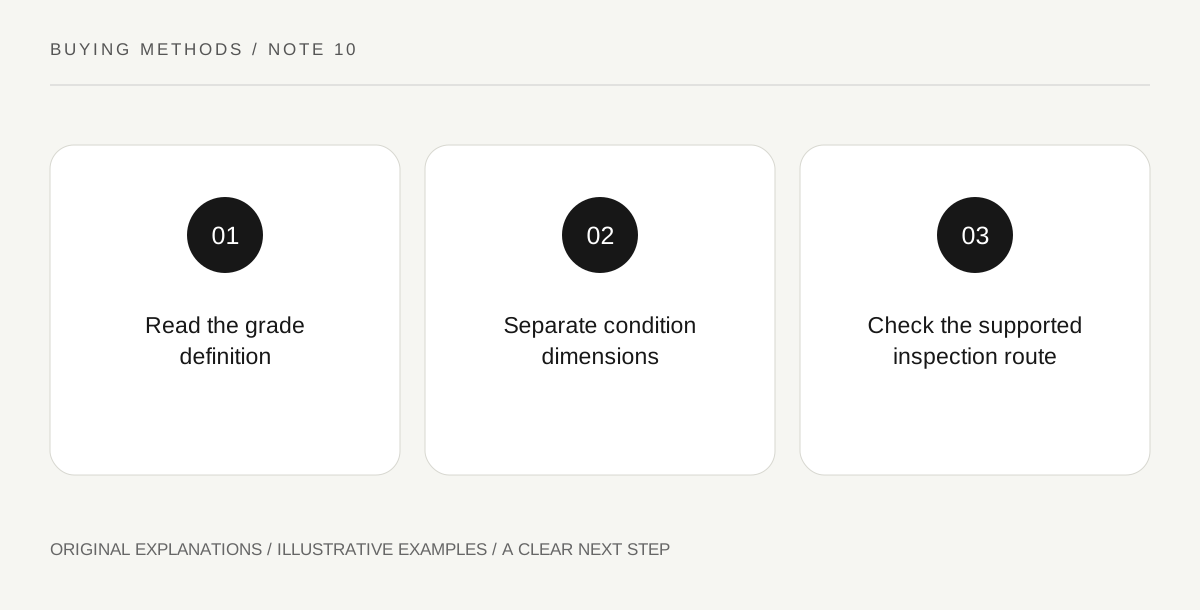
Original explanatory diagram. Read the full method and limitations below.
Find the seller's own definition
Read the grading description attached to the current program and product. The FTC notes that condition-related terms such as refurbished can signal less-than-perfect condition. Do not assume every seller uses the same grade names or inspection process. A letter grade may concern cosmetics while leaving other questions open. Copy the definition and date, then ask about a material ambiguity rather than inferring a technical standard from a reassuring adjective.
Separate appearance from function
Scratches, missing packaging and a functional fault are different observations. Ask what testing or restoration the seller actually states and what documentation comes with the item. Do not invent a battery condition, component replacement or remaining lifespan simply because the exterior looks clean. Product photographs may be representative rather than images of the exact unit. Identify which claims apply to the individual item and which describe the program generally.
Check accessories and ongoing support
Confirm that required approved parts, chargers, instructions or account-transfer steps are included where relevant. A used connected device may need a clear supported ownership setup, while a physically similar accessory may not be compatible. Read the actual warranty and return terms for this condition category rather than borrowing those of the new product. If an essential safety or support question remains unclear, choose another offer instead of planning an unsupported repair immediately after purchase.
Inspect within the permitted process
On arrival, compare the item and identifier with the saved description and carry out only the supported checks appropriate to the product. Record any mismatch factually and use the seller's stated resolution route. Do not dismantle an item or bypass safety features to prove that a vague grade was optimistic. A lower price can be reasonable when the condition and terms fit your needs, but the discount does not make every unresolved uncertainty acceptable.
Illustrative worked example
Illustrative scenario: two refurbished listings use the phrase excellent condition. One defines it as a cosmetic grade, while the other separately states its inspection and included accessories. The shopper records those differences and asks about the first offer's missing functional information. They compare complete supported offers rather than assuming the matching adjective establishes identical restoration quality.
Questions that come up
Does refurbished always mean the manufacturer rebuilt it?
Do not assume who performed the work. Read the actual program, seller and stated process, asking for clarification when that identity matters.
Can a clean exterior prove remaining lifespan?
No. Appearance is one observation and does not establish internal condition or a future service period. Keep unprovided information unknown.
References and scope
These sources support the factual background. Examples and exercises are original illustrative teaching material. References do not imply endorsement.
- FTC: Online Shopping — Compare sellers, products and terms and keep purchase records; no universal refund entitlement is inferred.
- FTC: Warranties — Read written coverage and distinguish included warranty from separately sold service contracts; details vary.