Ask compared with what before accepting a performance percentage
A claim that a product is faster, quieter or more efficient needs a comparison baseline to mean anything useful. Copy the complete statement and its conditions before deciding whether it answers your task. The exercise evaluates the information available, without declaring a named advertisement unlawful from a cropped screenshot.
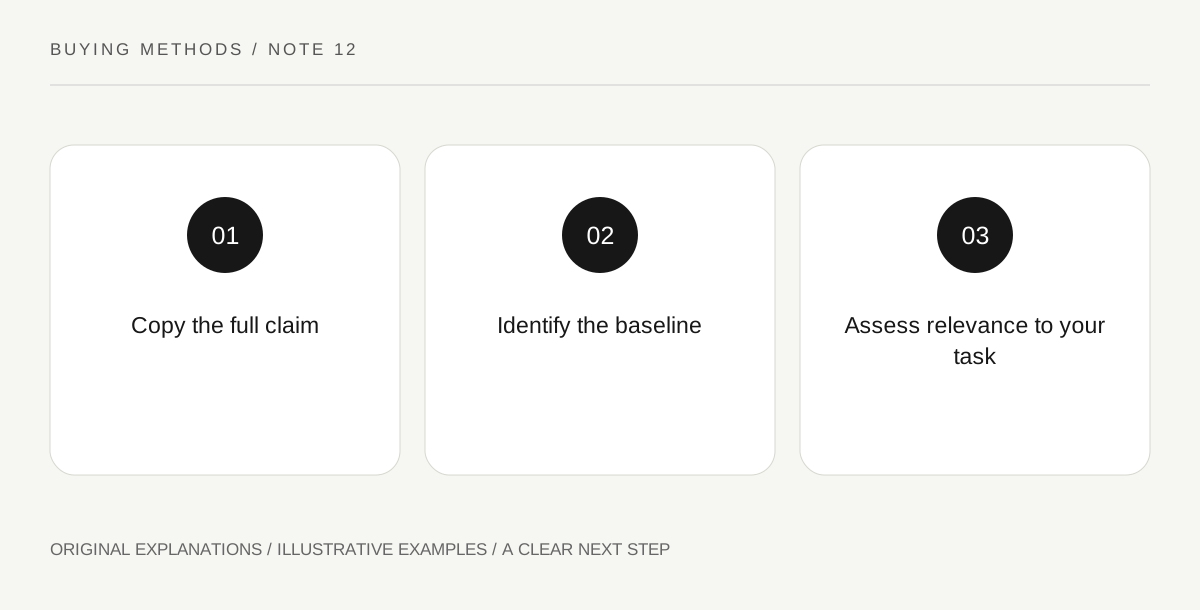
Original explanatory diagram. Read the full method and limitations below.
Preserve the complete wording
Save the claim together with nearby qualifications, date and product identity. A large percentage may refer to one mode, one test or a previous model. Removing that context can change the apparent meaning. The FTC's advertising guidance emphasizes substantiation of claims and relevant qualifications. As a consumer, begin by identifying what is actually being asserted rather than paraphrasing it into a stronger promise that the seller did not make.
Name the comparison target
Look for the product, reference condition or procedure used as the baseline. Faster than our earlier model is different from faster than every alternative. A maximum result is different from a typical result under your conditions. If the baseline is missing, record that gap and ask the manufacturer. Do not fill it with the competitor you happened to be considering. The comparison is meaningful only when both sides and the measured outcome are sufficiently clear.
Connect the test to your real task
Ask whether the claimed improvement concerns something you will actually use. A shorter specialist cycle may not describe the routine operation you need, and a lower noise figure under one setting may not represent another. Keep this as a relevance question rather than assuming every laboratory condition is deceptive. A controlled test can be informative while still differing from your household. Reliable technical documentation should explain the scope more clearly than a slogan alone.
Choose an evidence-based conclusion
Write what the available claim supports, what it does not and whether the unresolved gap matters to the purchase. You may decide the feature is irrelevant and choose on another basis, or pause if it is the main reason for buying. Avoid inventing a failure rate or guaranteed saving from a single performance percentage. Keep any subsequent product trial within instructions and return terms; an advertised claim is not permission to push equipment beyond its supported limits.
Illustrative worked example
Illustrative scenario: an appliance advertisement says a mode is thirty percent faster. The shopper finds that the comparison uses a previous model's specialist cycle, while their routine task uses a different mode. They keep the claim accurately bounded and compare the ordinary operating information instead. The percentage is neither ignored nor expanded into a promise that every task finishes thirty percent sooner.
Questions that come up
Does up to guarantee the result I will get?
A maximum-style phrase does not independently establish your ordinary outcome. Read the conditions and ask what evidence applies to your actual use.
Can I prove an ad is false because my experience differs?
One experience may justify a question or complaint, but a legal conclusion requires the full facts and applicable standards. Keep the record factual and seek appropriate guidance.
References and scope
These sources support the factual background. Examples and exercises are original illustrative teaching material. References do not imply endorsement.
- FTC: Advertising FAQs — Advertising claims and relevant qualifications require substantiation; the collection teaches reading, not legal adjudication.
- FTC: Online Shopping — Compare sellers, products and terms and keep purchase records; no universal refund entitlement is inferred.