Read whether an environmental claim concerns the product, package or disposal route
An environmental symbol can draw attention away from the precise claim beside it. Identify what the statement covers before treating it as a verdict on the entire purchase. Product material, packaging content and end-of-life instructions are different questions, each needing its own scope and evidence.
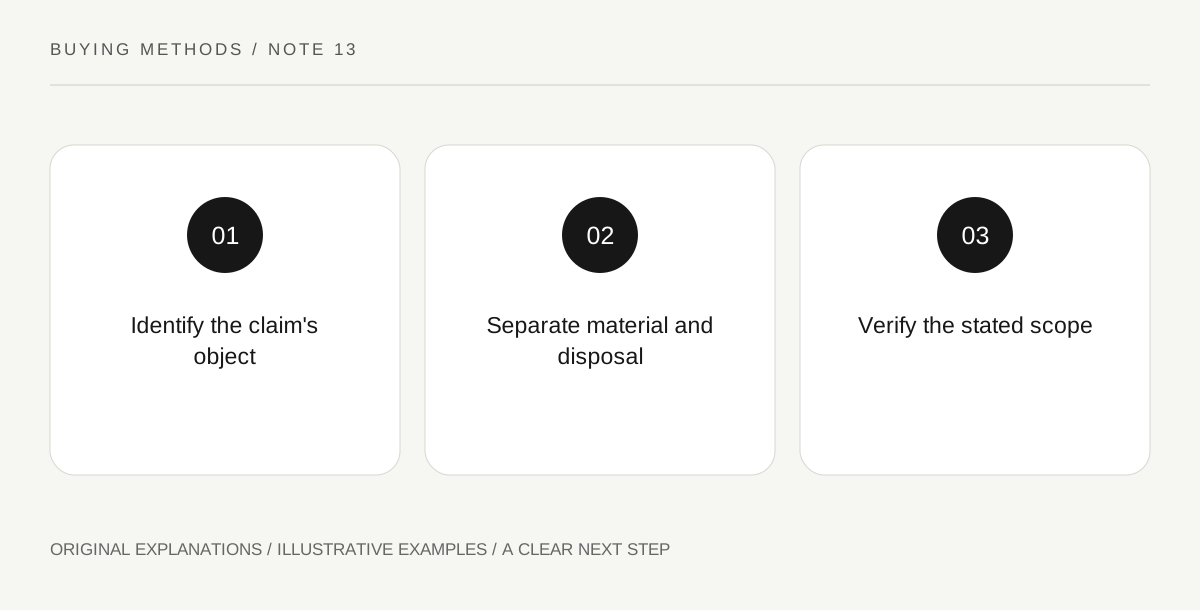
Original explanatory diagram. Read the full method and limitations below.
Copy the object of the claim
Underline whether the wording refers to the item, one component, the outer carton or another defined part. The FTC's Green Guides summary distinguishes several environmental claim types and their qualifications. A recycled-content statement about a box does not automatically describe the product inside it. Keep the percentage, component and qualifying text together. A leaf illustration can signal a theme, but it cannot independently answer what material or process was actually assessed.
Distinguish content from future handling
Recycled content concerns material in the product or package, while recyclability concerns a possible future route. Compostable language introduces another set of conditions and facilities. Do not treat these words as interchangeable. Read the exact statement and check relevant local disposal information for the material you will actually handle. A product that requires a particular facility may not have that route available where you live. Avoid guessing that ordinary household recycling accepts it because the package looks familiar.
Ask for the relevant evidence
Look for a credible certification or specific manufacturer explanation that matches the claim's scope. Identify who operates a logo program and what its criteria actually cover. A self-declared statement is not automatically false, but it should not be silently upgraded into independent verification. Conversely, one certified component does not certify every aspect of the finished product's life. If the claim is a major purchase reason, resolve that boundary rather than relying on a broad impression of greenness.
Keep the whole decision practical
Consider whether you need the product and can use and maintain it appropriately. An appealing environmental claim does not make an unnecessary item necessary. Do not invent a complete life-cycle ranking from one material percentage or assume a heavier reusable object always wins under every use pattern. State the supported benefit narrowly, retain uncertainty and choose according to the actual task. The method improves claim reading without pretending to perform a full environmental assessment.
Illustrative worked example
Illustrative scenario: a shopper sees a prominent recycled symbol and assumes the entire appliance is made from recycled material. The adjacent text actually refers to the shipping carton. They correct the note and look for separate product information. The package claim may still be useful, but it no longer supplies an unsupported conclusion about every component or the best disposal route for the appliance.
Questions that come up
Does a leaf logo prove independent certification?
No universal meaning follows from the image. Identify the program, operator and actual criteria before treating it as a verified claim.
Can one percentage establish the most sustainable choice?
A single material statement does not cover every life-cycle factor or use pattern. Keep the conclusion narrow and consider whether the product serves a real need.
References and scope
These sources support the factual background. Examples and exercises are original illustrative teaching material. References do not imply endorsement.
- FTC: Green Guides Summary — Environmental claims need specific scope and substantiation; product, packaging and disposal claims differ.