Verify an efficiency badge against the exact model and program scope
A certification badge is useful when the product, program and claim line up. Check the exact model in the relevant official source rather than trusting a small logo in a marketplace image. Then keep the certification's defined scope separate from broader claims about durability, suitability or total ownership cost.
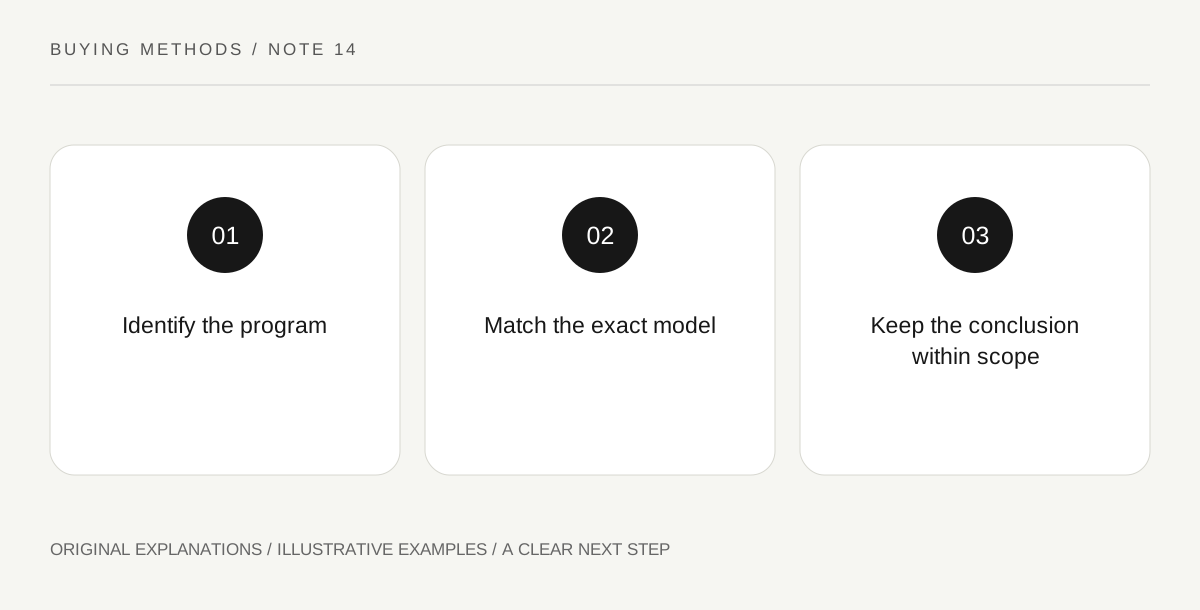
Original explanatory diagram. Read the full method and limitations below.
Identify the actual program
Read the name beside the mark and find the program's official explanation. EPA's ENERGY STAR Product Finder provides a route to information about certified products. Do not confuse that program with every other energy label or an informal efficient badge created by a seller. A clear program identity lets you check what is being assessed. It also prevents a familiar-looking symbol from silently borrowing the authority of a different certification system.
Match the full model identifier
Use the actual model and relevant configuration rather than a broad product family name. Keep suffixes and listed conditions where the program provides them. If a listing cannot be matched, treat that as an unresolved question rather than immediate proof of deception or automatic certification. Ask the manufacturer or program through a verified route when the difference matters. Save the current record with the offer so the delivered identifier can be checked against what you evaluated.
Read what certification establishes
ENERGY STAR concerns defined energy-efficiency specifications. That scope does not independently establish quietness, accessibility, every safety requirement or how well a product fits your room. Keep those questions in their own columns. A certification may help narrow the candidates while leaving the final purchase unresolved. Avoid turning one legitimate mark into a universal recommendation or assuming an uncertified product necessarily lacks every desirable characteristic. The relevant conclusion follows the program's actual criteria.
Separate standardized comparison from your bill
An energy-use estimate or cost label can use specified assumptions, while your actual operation and local prices may differ. Read those assumptions before projecting a household saving. Keep the certification record, any energy-use figure and your own scenario distinct. Do not claim a guaranteed payback time unless all relevant inputs are reliable and the limitation is explicit. A useful buying note can simply say verified model in this program, with practical fit and expected use still to compare.
Illustrative worked example
Illustrative scenario: a shopper finds an efficiency logo on a shared listing. The official finder identifies one specific model suffix, while the selected offer shows another. They ask for clarification before counting the badge as evidence. Once identity is resolved, they keep energy certification separate from noise and fit questions, producing a comparison with clear supported and unresolved fields.
Questions that come up
Does an efficiency mark guarantee the best overall product?
It addresses defined program criteria. Your task, fit, operating requirements and other relevant evidence still matter.
Are EnergyGuide and ENERGY STAR identical?
They serve different information roles. Read each program's official description rather than treating every energy-related label as the same certification or cost promise.
References and scope
These sources support the factual background. Examples and exercises are original illustrative teaching material. References do not imply endorsement.
- EPA: ENERGY STAR Product Finder — Verify exact models in the certification program; certification has a defined energy-efficiency scope.
- FTC: EnergyGuide Consumer Guide — EnergyGuide provides energy-use and cost comparison information with assumptions, distinct from certification scope.